
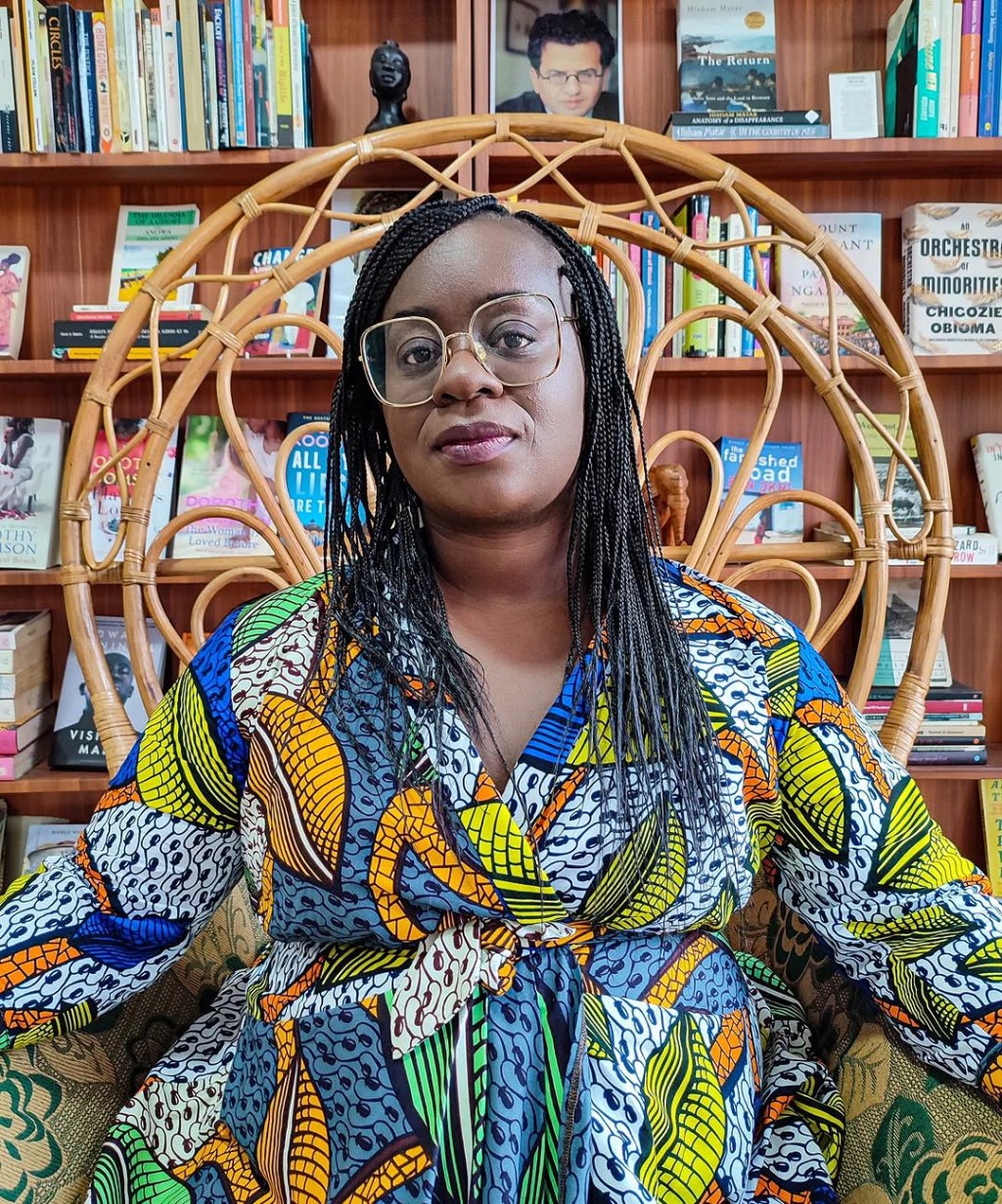
Being a Scholar While Being a Black Borga Ba: Discovering LOATAD as an Elusive Exile by Andrea-Vicky Amankwaa-Birago
I am a Borga Ba. “Borga” is a fusion of Hamburg and Kumasi, symbolising the lived experience of migrants who arrived in Germany around Ghana’s period of democratisation and post-independence. These migrants and their descendants, “Ba” (child), exist in a form of status production — a life shaped by displacement and belonging, yet often without a formal archive or historical record to hold onto.
I write from a void, a space shaped by Ghanaian migration histories, diaspora, and the ongoing struggle to claim intellectual and cultural space. This “void” is a place without a fixed archive — where migrants who came to Hamburg after Ghana’s independence live in a precarious, often unrecorded status production. It is from this place, as a daughter, a descendant, and a woman, that I conduct what I call Situated Ancestry Research — a practice that intertwines personal lineage with broader socio-political narratives, reclaiming fragmented histories and making them visible.
In 2020, at the height of the COVID-19 pandemic, I reached out to Sylvia Arthur, the founder of LOATAD — the Library of Africa and the African Diaspora. I came across the name online, and something in me stirred. There was an immediate emotional and intellectual resonance. A library for Africa and the African diaspora? Was that even possible? Could a space exist that held the fragments of our multiple, scattered, yet connected memories?
When I eventually walked into LOATAD, it felt like stepping into a living archive, not just of books, but of memory and spirit. The space enchanted me. Not only because of its curated collection of Black history, African literature, and diasporic knowledge, but because of what it evoked: a sanctuary. One particular image stayed with me: a portrait of Toni Morrison, hanging right at the exit. A symbolic guardian of return, welcoming all those who longed to come back but never could. On the door, a simple word: “Return.” It echoed Sankofa, the Ghanaian wisdom which teaches us to go back and retrieve what was lost, in order to move forward.
LOATAD offered something radically different: stillness. It was not a place on a map, but a spiritual location.
That moment stayed with me. For years, I had been living what I now call an elusive exile. This term encapsulates the subtle, often hidden ways in which displacement manifests itself. It is not just geographical. It is intellectual. Emotional. Spiritual. An elusive exile is not always visible; it hides behind academic jargon, behind citations, behind performance. In the academy, especially as a Black scholar working on figures like Anton Wilhelm Amo, I have often felt like the lion being hunted — always watched, always doubted, always needing to prove.
But LOATAD offered something radically different: stillness. It was not a place on a map, but a spiritual location. A place where I could sit in conversation with Amo, our ancestor. Amo, the philosopher and the librarian, the displaced and the returned. This dialogue is not neutral. It is filled with grief, with questions: How was Amo taken? How did he feel? What did return mean for him? What silences did he carry? What violence had no words?
These are not questions one can ask in the fluorescent lights of Western institutions. They require protected, quiet spaces. They require archives that speak to ancestral presence, not just colonial classification. They require the courage to sit with pain.
It was at LOATAD that I had time and permission to follow these paths. I encountered a rare gem: the “Selected Speeches of Kwame Nkrumah,” edited by Samuel Obeng. And there, unexpectedly, I read something that affirmed my journey: Nkrumah himself had mentioned Anton Wilhelm Amo in his reflections on Pan-Africanism. In speeches dating back to the late 1950s, he positioned Amo as a precursor to African intellectual sovereignty. This was not only a discovery; it was a return. A Sankofa moment. It revealed that my dialogue with Amo was not isolated, but part of a broader Pan-African memory movement that spans generations and geographies.
Being in Ghana allowed me to move between forms of knowledge-making.
And yet, even within the archive, one absence haunted me deeply: the missing mother. Amo’s mother is unmentioned in most historical accounts. Her absence is not just biographical. It is symbolic. It speaks to the gaps that displacement creates in the lives of the displaced. As a Borga Ba, this silence felt personal. It mirrored the broader silence around Black maternal memory and the violence of erasure that colonial archives often perform. In LOATAD, I could finally ask: What happens when the mother is missing from the archive? And what does that mean for the child — the Borga Ba?
Being in Ghana allowed me to move between forms of knowledge-making. I spoke with memory entrepreneurs like Sylvia, with chiefs who hold ancestral records in places like Axim and Shama, with activists and academic peers across local and transnational spaces. This fluid movement between worlds — academic and ancestral, activist and archival — was only possible because I had a space to rest and recompose. LOATAD held that space.
In all of this, my aim is not to rewrite history, but to complement it — from my own epistemological location. As the Twi proverb reminds us: “Sɔnɔ kɔtɔ nni dua so a, ne bo nwu.” — “When the elephant doesn’t stand on a tree, its bones do not break.” Our stories endure, even when we cannot see all their parts. Even when the mother is missing. Even when we write in exile.
This is what being a Borga Ba scholar means to me. It is not about authority. It is about responsibility. It is about listening. It is about return. It is about allowing the past to speak so that we can speak forward.
Andrea-Vicky Amankwaa-Birago, MA, is a cultural studies scholar, systemic coach, and research associate at HTW Berlin. She is currently pursuing her PhD in Memory Studies and is part of the Anthropology of Global Inequalities research group at the University of Bayreuth. Her work bridges anti-racist practice, artistic intervention, and ethnographic research.
 Library Of Africa and The African Diaspora